The Moon
月亮
The Moon
Upright · a modern reflection
Ambiguity, emotion, and imagination. Separate feelings, guesses, and known facts.
Reversed · another perspective
Emerging clarity or suppressed feelings. Check gently without rushing to a conclusion.
These are our original interpretations of RWS imagery, not word-for-word translations of Waite. Reversals offer another angle, not a verdict of bad luck.A. E. Waite · XVIII. The Moon
“The distinction between this card and some of the conventional types is that the moon is increasing on what is called the side of mercy,…”This English excerpt comes from the original card chapter. We use Pamela Colman Smith’s original RWS images from the Commons Pam-A scans. The design originated in 1909; this scan set is dated 1910.
Read this card’s original chapter ↗Historical imagery and symbolism
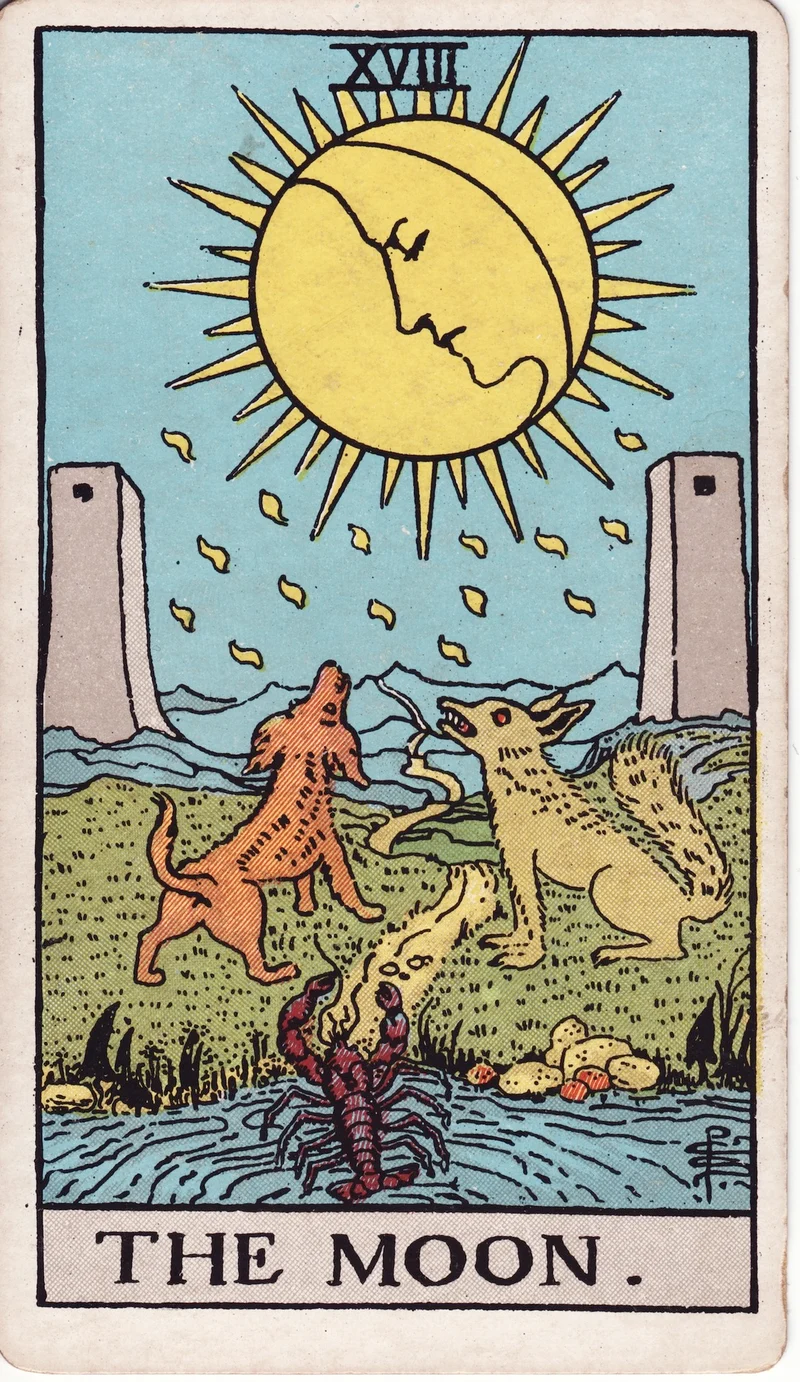
The distinction between this card and some of the conventional types is that the moon is increasing on what is called the side of mercy, to the right of the observer. It has sixteen chief and sixteen secondary rays. The card represents life of the imagination apart from life of the spirit. The path between the towers is the issue into the unknown. The dog and wolf are the fears of the natural mind in the presence of that place of exit, when there is only reflected light to guide it.
Card image: Pamela Colman Smith’s original RWS design, using the Commons Pam-A scans.
Historical reversal and interpretation
Instability, inconstancy, silence, lesser degrees of deception and error.
Contemporary reading
Consider the historical conditions above; a reversal is not a uniform opposite. Compare them with our modern theme: Emerging clarity or suppressed feelings. Check gently without rushing to a conclusion.
Relate it to your question
Separate known facts, unconfirmed information and available actions. Which part of this symbol fits, and which does not?
Read the original English and source
Pamela Colman Smith · Image source / Public domain ↗
The distinction between this card and some of the conventional types is that the moon is increasing on what is called the side of mercy, to the right of the observer. It has sixteen chief and sixteen secondary rays. The card represents life of the imagination apart from life of the spirit. The path between the towers is the issue into the unknown. The dog and wolf are the fears of the natural mind in the presence of that place of exit, when there is only reflected light to guide it. The last reference is a key to another form of symbolism. The intellectual light is a reflection and beyond it is the unknown mystery which it cannot shew forth. It illuminates our animal nature, types of which are represented below--the dog, the wolf and that which comes up out of the deeps, the nameless and hideous tendency which is lower than the savage beast. It strives to attain manifestation, symbolized by crawling from the abyss of water to the land, but as a rule it sinks back whence it came. The face of the mind directs a calm gaze upon the unrest below; the dew of thought falls; the message is: Peace, be still; and it may be that there shall come a calm upon the animal nature, while the abyss beneath shall cease from giving up a form.
18. THE MOON.--Hidden enemies, danger, calumny, darkness, terror, deception, occult forces, error. Reversed: Instability, inconstancy, silence, lesser degrees of deception and error.
A. E. Waite · XVIII. The Moon ↗Part III §3 · Major divinatory meanings, distinct from Part II symbolism ↗
Bring the symbol into your day
How might “The Moon” relate to your circumstances? List the facts you already know, then consider one action within your control.
Primary texts you can consult
《周易》· Chinese Text Project ↗
Read the judgments and line texts separately from the later commentarial Wings. Traditional authorship accounts are not treated as established historical fact.
Zhouyi, received text · Digital Chinese Classics ↗
Each hexagram’s classical text is extracted from its chapter. Traditional characters and editorial punctuation are retained; modern annotations are not reproduced.
A. E. Waite · The Pictorial Key to the Tarot ↗
First published in 1910; our reference is the 1911 text transcribed by Sacred Texts. Written by A. E. Waite, with original card designs by Pamela Colman Smith.
Historical imagery and symbolism
The distinction between this card and some of the conventional types is that the moon is increasing on what is called the side of mercy, to the right of the observer. It has sixteen chief and sixteen secondary rays. The card represents life of the imagination apart from life of the spirit. The path between the towers is the issue into the unknown. The dog and wolf are the fears of the natural mind in the presence of that place of exit, when there is only reflected light to guide it.
Card image: Pamela Colman Smith’s original RWS design, using the Commons Pam-A scans.
Contemporary reading
Ambiguity, emotion, and imagination. Separate feelings, guesses, and known facts.
Relate it to your question
Separate known facts, unconfirmed information and available actions. Which part of this symbol fits, and which does not?
Read the original English and source
Pamela Colman Smith · Image source / Public domain ↗
The distinction between this card and some of the conventional types is that the moon is increasing on what is called the side of mercy, to the right of the observer. It has sixteen chief and sixteen secondary rays. The card represents life of the imagination apart from life of the spirit. The path between the towers is the issue into the unknown. The dog and wolf are the fears of the natural mind in the presence of that place of exit, when there is only reflected light to guide it. The last reference is a key to another form of symbolism. The intellectual light is a reflection and beyond it is the unknown mystery which it cannot shew forth. It illuminates our animal nature, types of which are represented below--the dog, the wolf and that which comes up out of the deeps, the nameless and hideous tendency which is lower than the savage beast. It strives to attain manifestation, symbolized by crawling from the abyss of water to the land, but as a rule it sinks back whence it came. The face of the mind directs a calm gaze upon the unrest below; the dew of thought falls; the message is: Peace, be still; and it may be that there shall come a calm upon the animal nature, while the abyss beneath shall cease from giving up a form.
18. THE MOON.--Hidden enemies, danger, calumny, darkness, terror, deception, occult forces, error. Reversed: Instability, inconstancy, silence, lesser degrees of deception and error.
A. E. Waite · XVIII. The Moon ↗Part III §3 · Major divinatory meanings, distinct from Part II symbolism ↗