The High Priestess
女祭司
The High Priestess
Upright · a modern reflection
Intuition and the unspoken. Make space to notice information that has not yet become clear.
Reversed · another perspective
Overlooked feelings or missing information. Give judgment time and verify the facts.
These are our original interpretations of RWS imagery, not word-for-word translations of Waite. Reversals offer another angle, not a verdict of bad luck.A. E. Waite · II. The High Priestess
“She has the lunar crescent at her feet, a horned diadem on her head, with a globe in the middle place, and a large solar…”This English excerpt comes from the original card chapter. We use Pamela Colman Smith’s original RWS images from the Commons Pam-A scans. The design originated in 1909; this scan set is dated 1910.
Read this card’s original chapter ↗Historical imagery and symbolism
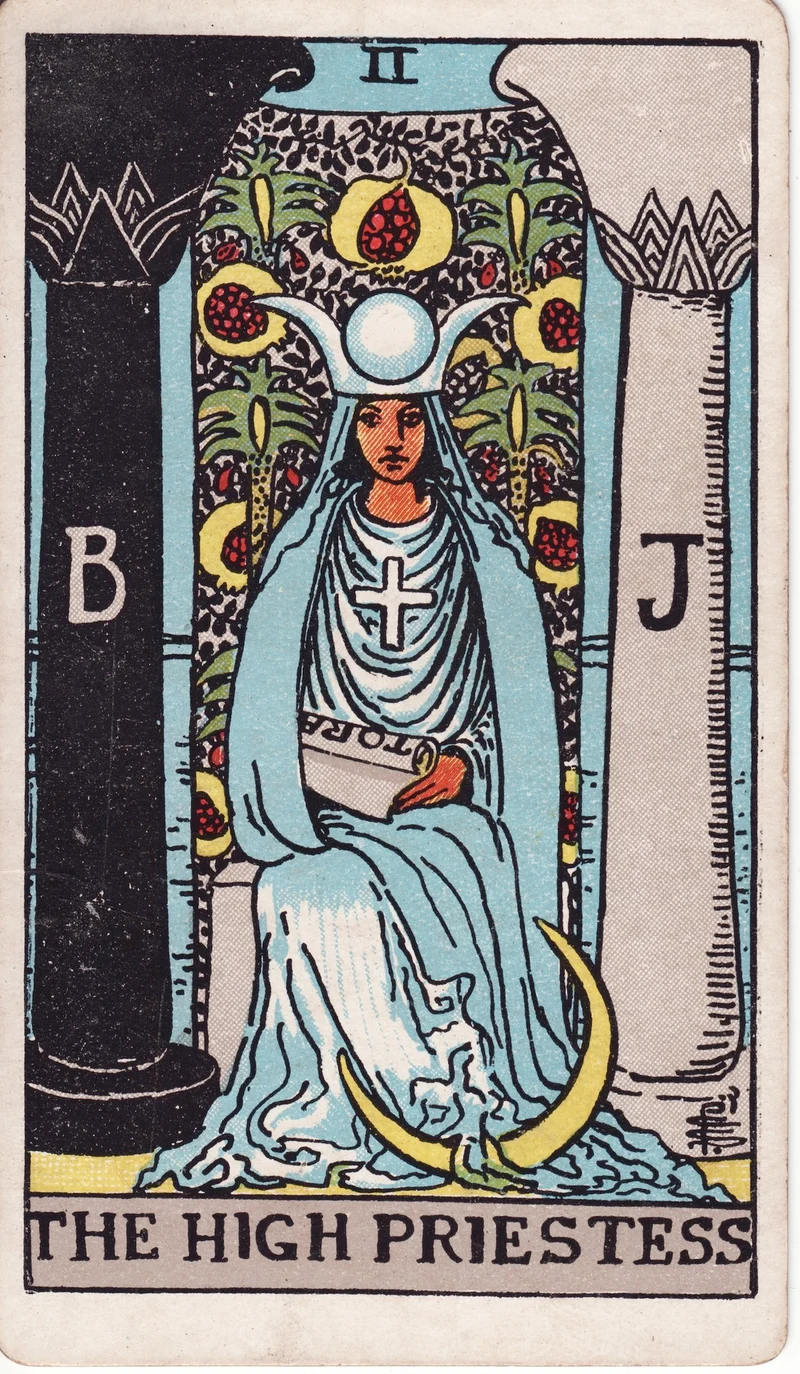
She has the lunar crescent at her feet, a horned diadem on her head, with a globe in the middle place, and a large solar cross on her breast. The scroll in her hands is inscribed with the word Tora, signifying the Greater Law, the Secret Law and the second sense of the Word. It is partly covered by her mantle, to shew that some things are implied and some spoken. She is seated between the white and black pillars--J. and B.--of the mystic Temple, and the veil of the Temple is behind her: it is embroidered with palms and pomegranates. The vestments are flowing and gauzy, and the mantle suggests light--a shimmering radiance. She has been called occult Science on the threshold of the Sanctuary of Isis, but she is really the Secret Church, the House which is of God and man. She represents also the Second Marriage of the Prince who is no longer of this world; she is the spiritual Bride and Mother, the daughter of the stars and the Higher Garden of Eden. She is, in fine, the Queen of the borrowed light, but this is the light of all. She is the Moon nourished by the milk of the Supernal Mother.
Card image: Pamela Colman Smith’s original RWS design, using the Commons Pam-A scans.
Historical reversal and interpretation
Passion, moral or physical ardour, conceit, surface knowledge.
Contemporary reading
Consider the historical conditions above; a reversal is not a uniform opposite. Compare them with our modern theme: Overlooked feelings or missing information. Give judgment time and verify the facts.
Relate it to your question
Separate known facts, unconfirmed information and available actions. Which part of this symbol fits, and which does not?
Read the original English and source
Pamela Colman Smith · Image source / Public domain ↗
She has the lunar crescent at her feet, a horned diadem on her head, with a globe in the middle place, and a large solar cross on her breast. The scroll in her hands is inscribed with the word Tora, signifying the Greater Law, the Secret Law and the second sense of the Word. It is partly covered by her mantle, to shew that some things are implied and some spoken. She is seated between the white and black pillars--J. and B.--of the mystic Temple, and the veil of the Temple is behind her: it is embroidered with palms and pomegranates. The vestments are flowing and gauzy, and the mantle suggests light--a shimmering radiance. She has been called occult Science on the threshold of the Sanctuary of Isis, but she is really the Secret Church, the House which is of God and man. She represents also the Second Marriage of the Prince who is no longer of this world; she is the spiritual Bride and Mother, the daughter of the stars and the Higher Garden of Eden. She is, in fine, the Queen of the borrowed light, but this is the light of all. She is the Moon nourished by the milk of the Supernal Mother. In a manner, she is also the Supernal Mother herself--that is to say, she is the bright reflection. It is in this sense of reflection that her truest and highest name in bolism is Shekinah--the co-habiting glory. According to Kabalism, there is a Shekinah both above and below. In the superior world it is called Binah, the Supernal Understanding which reflects to the emanations that are beneath. In the lower world it is MaIkuth--that world being, for this purpose, understood as a blessed Kingdom that with which it is made blessed being the Indwelling Glory. Mystically speaking, the Shekinah is the Spiritual Bride of the just man, and when he reads the Law she gives the Divine meaning. There are some respects in which this card is the highest and holiest of the Greater Arcana.
2. THE HIGH PRIESTESS.--Secrets, mystery, the future as yet unrevealed; the woman who interests the Querent, if male; the Querent herself, if female; silence, tenacity; mystery, wisdom, science. Reversed: Passion, moral or physical ardour, conceit, surface knowledge.
A. E. Waite · II. The High Priestess ↗Part III §3 · Major divinatory meanings, distinct from Part II symbolism ↗
Bring the symbol into your day
How might “The High Priestess” relate to your circumstances? List the facts you already know, then consider one action within your control.
Primary texts you can consult
《周易》· Chinese Text Project ↗
Read the judgments and line texts separately from the later commentarial Wings. Traditional authorship accounts are not treated as established historical fact.
Zhouyi, received text · Digital Chinese Classics ↗
Each hexagram’s classical text is extracted from its chapter. Traditional characters and editorial punctuation are retained; modern annotations are not reproduced.
A. E. Waite · The Pictorial Key to the Tarot ↗
First published in 1910; our reference is the 1911 text transcribed by Sacred Texts. Written by A. E. Waite, with original card designs by Pamela Colman Smith.
Historical imagery and symbolism
She has the lunar crescent at her feet, a horned diadem on her head, with a globe in the middle place, and a large solar cross on her breast. The scroll in her hands is inscribed with the word Tora, signifying the Greater Law, the Secret Law and the second sense of the Word. It is partly covered by her mantle, to shew that some things are implied and some spoken. She is seated between the white and black pillars--J. and B.--of the mystic Temple, and the veil of the Temple is behind her: it is embroidered with palms and pomegranates. The vestments are flowing and gauzy, and the mantle suggests light--a shimmering radiance. She has been called occult Science on the threshold of the Sanctuary of Isis, but she is really the Secret Church, the House which is of God and man. She represents also the Second Marriage of the Prince who is no longer of this world; she is the spiritual Bride and Mother, the daughter of the stars and the Higher Garden of Eden. She is, in fine, the Queen of the borrowed light, but this is the light of all. She is the Moon nourished by the milk of the Supernal Mother.
Card image: Pamela Colman Smith’s original RWS design, using the Commons Pam-A scans.
Contemporary reading
Intuition and the unspoken. Make space to notice information that has not yet become clear.
Relate it to your question
Separate known facts, unconfirmed information and available actions. Which part of this symbol fits, and which does not?
Read the original English and source
Pamela Colman Smith · Image source / Public domain ↗
She has the lunar crescent at her feet, a horned diadem on her head, with a globe in the middle place, and a large solar cross on her breast. The scroll in her hands is inscribed with the word Tora, signifying the Greater Law, the Secret Law and the second sense of the Word. It is partly covered by her mantle, to shew that some things are implied and some spoken. She is seated between the white and black pillars--J. and B.--of the mystic Temple, and the veil of the Temple is behind her: it is embroidered with palms and pomegranates. The vestments are flowing and gauzy, and the mantle suggests light--a shimmering radiance. She has been called occult Science on the threshold of the Sanctuary of Isis, but she is really the Secret Church, the House which is of God and man. She represents also the Second Marriage of the Prince who is no longer of this world; she is the spiritual Bride and Mother, the daughter of the stars and the Higher Garden of Eden. She is, in fine, the Queen of the borrowed light, but this is the light of all. She is the Moon nourished by the milk of the Supernal Mother. In a manner, she is also the Supernal Mother herself--that is to say, she is the bright reflection. It is in this sense of reflection that her truest and highest name in bolism is Shekinah--the co-habiting glory. According to Kabalism, there is a Shekinah both above and below. In the superior world it is called Binah, the Supernal Understanding which reflects to the emanations that are beneath. In the lower world it is MaIkuth--that world being, for this purpose, understood as a blessed Kingdom that with which it is made blessed being the Indwelling Glory. Mystically speaking, the Shekinah is the Spiritual Bride of the just man, and when he reads the Law she gives the Divine meaning. There are some respects in which this card is the highest and holiest of the Greater Arcana.
2. THE HIGH PRIESTESS.--Secrets, mystery, the future as yet unrevealed; the woman who interests the Querent, if male; the Querent herself, if female; silence, tenacity; mystery, wisdom, science. Reversed: Passion, moral or physical ardour, conceit, surface knowledge.
A. E. Waite · II. The High Priestess ↗Part III §3 · Major divinatory meanings, distinct from Part II symbolism ↗