
Justice
正义
Justice
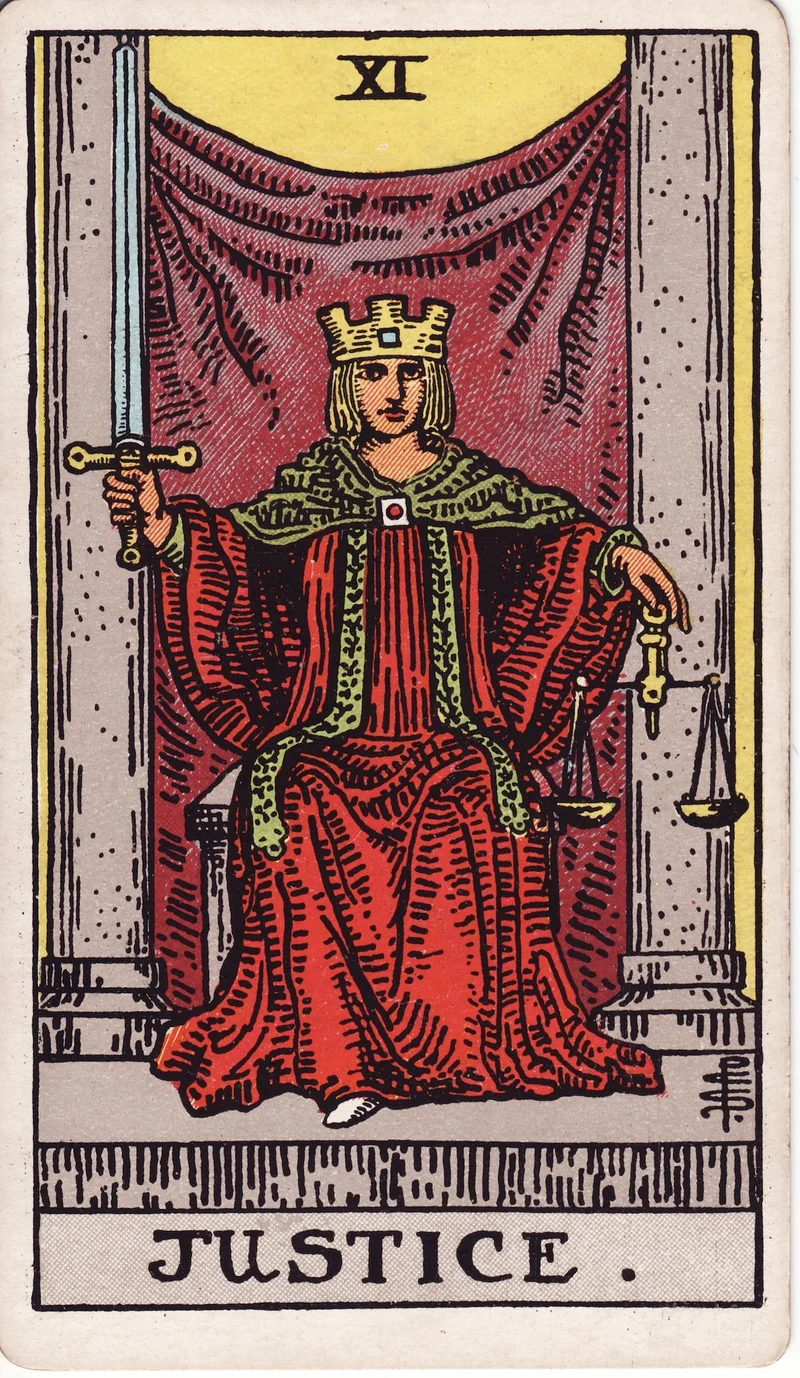
Upright · a modern reflection
Fairness, facts, and accountability. Consider consequences and make your reasoning clear.
Reversed · another perspective
Imbalance or avoided responsibility. Revisit the facts and each person's rights.
These are our original interpretations of RWS imagery, not word-for-word translations of Waite. Reversals offer another angle, not a verdict of bad luck.A. E. Waite · XI. Justice
“As this card follows the traditional symbolism and carries above all its obvious meanings, there is little to say regarding it outside the few considerations…”This English excerpt comes from the original card chapter. We use Pamela Colman Smith’s original RWS images from the Commons Pam-A scans. The design originated in 1909; this scan set is dated 1910.
Read this card’s original chapter ↗Historical imagery and symbolism
As this card follows the traditional symbolism and carries above all its obvious meanings, there is little to say regarding it outside the few considerations collected in the first part, to which the reader is referred.
Card image: Pamela Colman Smith’s original RWS design, using the Commons Pam-A scans.
Historical reversal and interpretation
Law in all its departments, legal complications, bigotry, bias, excessive severity.
Contemporary reading
Consider the historical conditions above; a reversal is not a uniform opposite. Compare them with our modern theme: Imbalance or avoided responsibility. Revisit the facts and each person's rights.
Relate it to your question
Separate known facts, unconfirmed information and available actions. Which part of this symbol fits, and which does not?
Read the original English and source
Pamela Colman Smith · Image source / Public domain ↗
As this card follows the traditional symbolism and carries above all its obvious meanings, there is little to say regarding it outside the few considerations collected in the first part, to which the reader is referred. It will be seen, however, that the figure is seated between pillars, like the High Priestess, and on this account it seems desirable to indicate that the moral principle which deals unto every man according to his works--while, of course, it is in strict analogy with higher things;--differs in its essence from the spiritual justice which is involved in the idea of election. The latter belongs to a mysterious order of Providence, in virtue of which it is possible for certain men to conceive the idea of dedication to the highest things. The operation of this is like the breathing of the Spirit where it wills, and we have no canon of criticism or ground of explanation concerning it. It is analogous to the possession of the fairy gifts and the high gifts and the gracious gifts of the poet: we have them or have not, and their presence is as much a mystery as their absence. The law of Justice is not however involved by either alternative. In conclusion, the pillars of Justice open into one world and the pillars of the High Priestess into another.
11. JUSTICE.--Equity, rightness, probity, executive; triumph of the deserving side in law. Reversed: Law in all its departments, legal complications, bigotry, bias, excessive severity.
A. E. Waite · XI. Justice ↗Part III §3 · Major divinatory meanings, distinct from Part II symbolism ↗
Bring the symbol into your day
How might “Justice” relate to your circumstances? List the facts you already know, then consider one action within your control.
Primary texts you can consult
《周易》· Chinese Text Project ↗
Read the judgments and line texts separately from the later commentarial Wings. Traditional authorship accounts are not treated as established historical fact.
Zhouyi, received text · Digital Chinese Classics ↗
Each hexagram’s classical text is extracted from its chapter. Traditional characters and editorial punctuation are retained; modern annotations are not reproduced.
A. E. Waite · The Pictorial Key to the Tarot ↗
First published in 1910; our reference is the 1911 text transcribed by Sacred Texts. Written by A. E. Waite, with original card designs by Pamela Colman Smith.
Historical imagery and symbolism
As this card follows the traditional symbolism and carries above all its obvious meanings, there is little to say regarding it outside the few considerations collected in the first part, to which the reader is referred.
Card image: Pamela Colman Smith’s original RWS design, using the Commons Pam-A scans.
Contemporary reading
Fairness, facts, and accountability. Consider consequences and make your reasoning clear.
Relate it to your question
Separate known facts, unconfirmed information and available actions. Which part of this symbol fits, and which does not?
Read the original English and source
Pamela Colman Smith · Image source / Public domain ↗
As this card follows the traditional symbolism and carries above all its obvious meanings, there is little to say regarding it outside the few considerations collected in the first part, to which the reader is referred. It will be seen, however, that the figure is seated between pillars, like the High Priestess, and on this account it seems desirable to indicate that the moral principle which deals unto every man according to his works--while, of course, it is in strict analogy with higher things;--differs in its essence from the spiritual justice which is involved in the idea of election. The latter belongs to a mysterious order of Providence, in virtue of which it is possible for certain men to conceive the idea of dedication to the highest things. The operation of this is like the breathing of the Spirit where it wills, and we have no canon of criticism or ground of explanation concerning it. It is analogous to the possession of the fairy gifts and the high gifts and the gracious gifts of the poet: we have them or have not, and their presence is as much a mystery as their absence. The law of Justice is not however involved by either alternative. In conclusion, the pillars of Justice open into one world and the pillars of the High Priestess into another.
11. JUSTICE.--Equity, rightness, probity, executive; triumph of the deserving side in law. Reversed: Law in all its departments, legal complications, bigotry, bias, excessive severity.
A. E. Waite · XI. Justice ↗Part III §3 · Major divinatory meanings, distinct from Part II symbolism ↗