Wheel of Fortune
命运之轮
Wheel of Fortune
Upright · a modern reflection
Cycles and change. Distinguish opportunity from controllable action and adapt.
Reversed · another perspective
Resistance or a repeating pattern. Identify a small part you can change.
These are our original interpretations of RWS imagery, not word-for-word translations of Waite. Reversals offer another angle, not a verdict of bad luck.A. E. Waite · X. Wheel of Fortune
“In this symbol I have again followed the reconstruction of Éliphas Lévi, who has furnished several variants. It is legitimate--as I have intimated--to use Egyptian…”This English excerpt comes from the original card chapter. We use Pamela Colman Smith’s original RWS images from the Commons Pam-A scans. The design originated in 1909; this scan set is dated 1910.
Read this card’s original chapter ↗Historical imagery and symbolism
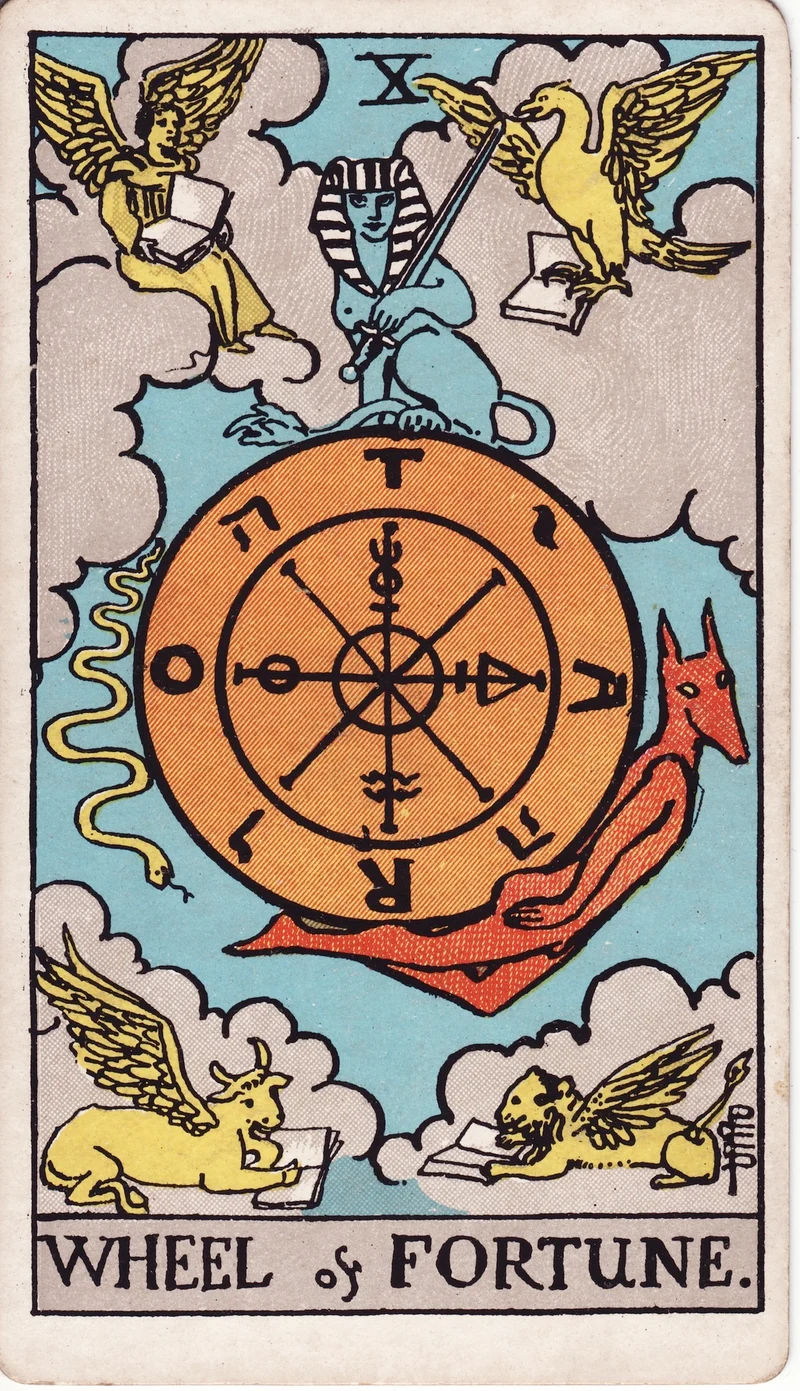
In this symbol I have again followed the reconstruction of Éliphas Lévi, who has furnished several variants. It is legitimate--as I have intimated--to use Egyptian symbolism when this serves our purpose, provided that no theory of origin is implied therein. I have, however, presented Typhon in his serpent form. The symbolism is, of course, not exclusively Egyptian, as the four Living Creatures of Ezekiel occupy the angles of the card, and the wheel itself follows other indications of Lévi in respect of Ezekiel's vision, as illustrative of the particular Tarot Key. With the French occultist, and in the design itself, the symbolic picture stands for the perpetual motion of a fluidic universe and for the flux of human life. The Sphinx is the equilibrium therein. The transliteration of Taro as Rota is inscribed on the wheel, counterchanged with the letters of the Divine Name--to shew that Providence is imphed through all. But this is the Divine intention within, and the similar intention without is exemplified by the four Living Creatures. Sometimes the sphinx is represented couchant on a pedestal above, which defrauds the symbolism by stultifying the essential idea of stability amidst movement.
Card image: Pamela Colman Smith’s original RWS design, using the Commons Pam-A scans.
Historical reversal and interpretation
Increase, abundance, superfluity.
Contemporary reading
Consider the historical conditions above; a reversal is not a uniform opposite. Compare them with our modern theme: Resistance or a repeating pattern. Identify a small part you can change.
Relate it to your question
Separate known facts, unconfirmed information and available actions. Which part of this symbol fits, and which does not?
Read the original English and source
Pamela Colman Smith · Image source / Public domain ↗
In this symbol I have again followed the reconstruction of Éliphas Lévi, who has furnished several variants. It is legitimate--as I have intimated--to use Egyptian symbolism when this serves our purpose, provided that no theory of origin is implied therein. I have, however, presented Typhon in his serpent form. The symbolism is, of course, not exclusively Egyptian, as the four Living Creatures of Ezekiel occupy the angles of the card, and the wheel itself follows other indications of Lévi in respect of Ezekiel's vision, as illustrative of the particular Tarot Key. With the French occultist, and in the design itself, the symbolic picture stands for the perpetual motion of a fluidic universe and for the flux of human life. The Sphinx is the equilibrium therein. The transliteration of Taro as Rota is inscribed on the wheel, counterchanged with the letters of the Divine Name--to shew that Providence is imphed through all. But this is the Divine intention within, and the similar intention without is exemplified by the four Living Creatures. Sometimes the sphinx is represented couchant on a pedestal above, which defrauds the symbolism by stultifying the essential idea of stability amidst movement. Behind the general notion expressed in the symbol there lies the denial of chance and the fatality which is implied therein. It may be added that, from the days of Lévi onward, the occult explanations of this card are--even for occultism itself--of a singularly fatuous kind. It has been said to mean principle, fecundity, virile honour, ruling authority, etc. The findings of common fortune-telling are better than this on their own plane.
10. WHEEL OF FORTUNE.-Destiny, fortune, success, elevation, luck, felicity. Reversed: Increase, abundance, superfluity.
A. E. Waite · X. Wheel of Fortune ↗Part III §3 · Major divinatory meanings, distinct from Part II symbolism ↗
Bring the symbol into your day
How might “Wheel of Fortune” relate to your circumstances? List the facts you already know, then consider one action within your control.
Primary texts you can consult
《周易》· Chinese Text Project ↗
Read the judgments and line texts separately from the later commentarial Wings. Traditional authorship accounts are not treated as established historical fact.
Zhouyi, received text · Digital Chinese Classics ↗
Each hexagram’s classical text is extracted from its chapter. Traditional characters and editorial punctuation are retained; modern annotations are not reproduced.
A. E. Waite · The Pictorial Key to the Tarot ↗
First published in 1910; our reference is the 1911 text transcribed by Sacred Texts. Written by A. E. Waite, with original card designs by Pamela Colman Smith.
Historical imagery and symbolism
In this symbol I have again followed the reconstruction of Éliphas Lévi, who has furnished several variants. It is legitimate--as I have intimated--to use Egyptian symbolism when this serves our purpose, provided that no theory of origin is implied therein. I have, however, presented Typhon in his serpent form. The symbolism is, of course, not exclusively Egyptian, as the four Living Creatures of Ezekiel occupy the angles of the card, and the wheel itself follows other indications of Lévi in respect of Ezekiel's vision, as illustrative of the particular Tarot Key. With the French occultist, and in the design itself, the symbolic picture stands for the perpetual motion of a fluidic universe and for the flux of human life. The Sphinx is the equilibrium therein. The transliteration of Taro as Rota is inscribed on the wheel, counterchanged with the letters of the Divine Name--to shew that Providence is imphed through all. But this is the Divine intention within, and the similar intention without is exemplified by the four Living Creatures. Sometimes the sphinx is represented couchant on a pedestal above, which defrauds the symbolism by stultifying the essential idea of stability amidst movement.
Card image: Pamela Colman Smith’s original RWS design, using the Commons Pam-A scans.
Contemporary reading
Cycles and change. Distinguish opportunity from controllable action and adapt.
Relate it to your question
Separate known facts, unconfirmed information and available actions. Which part of this symbol fits, and which does not?
Read the original English and source
Pamela Colman Smith · Image source / Public domain ↗
In this symbol I have again followed the reconstruction of Éliphas Lévi, who has furnished several variants. It is legitimate--as I have intimated--to use Egyptian symbolism when this serves our purpose, provided that no theory of origin is implied therein. I have, however, presented Typhon in his serpent form. The symbolism is, of course, not exclusively Egyptian, as the four Living Creatures of Ezekiel occupy the angles of the card, and the wheel itself follows other indications of Lévi in respect of Ezekiel's vision, as illustrative of the particular Tarot Key. With the French occultist, and in the design itself, the symbolic picture stands for the perpetual motion of a fluidic universe and for the flux of human life. The Sphinx is the equilibrium therein. The transliteration of Taro as Rota is inscribed on the wheel, counterchanged with the letters of the Divine Name--to shew that Providence is imphed through all. But this is the Divine intention within, and the similar intention without is exemplified by the four Living Creatures. Sometimes the sphinx is represented couchant on a pedestal above, which defrauds the symbolism by stultifying the essential idea of stability amidst movement. Behind the general notion expressed in the symbol there lies the denial of chance and the fatality which is implied therein. It may be added that, from the days of Lévi onward, the occult explanations of this card are--even for occultism itself--of a singularly fatuous kind. It has been said to mean principle, fecundity, virile honour, ruling authority, etc. The findings of common fortune-telling are better than this on their own plane.
10. WHEEL OF FORTUNE.-Destiny, fortune, success, elevation, luck, felicity. Reversed: Increase, abundance, superfluity.
A. E. Waite · X. Wheel of Fortune ↗Part III §3 · Major divinatory meanings, distinct from Part II symbolism ↗