
Knight of Wands
权杖骑士
Adventure and drive
Upright · a modern reflection
Keep enthusiasm in action while making room for follow-through.
Reversed · another perspective
Historical record: Rupture, division, interruption, discord. Read this in context, without treating the card as evidence about another person.
These are our original interpretations of RWS imagery, not word-for-word translations of Waite. Reversals offer another angle, not a verdict of bad luck.A. E. Waite · Knight of Wands
“He is shewn as if upon a journey, armed with a short wand, and although mailed is not on a warlike errand. He is passing…”This English excerpt comes from the original card chapter. We use Pamela Colman Smith’s original RWS images from the Commons Pam-A scans. The design originated in 1909; this scan set is dated 1910.
Read this card’s original chapter ↗Historical imagery and symbolism
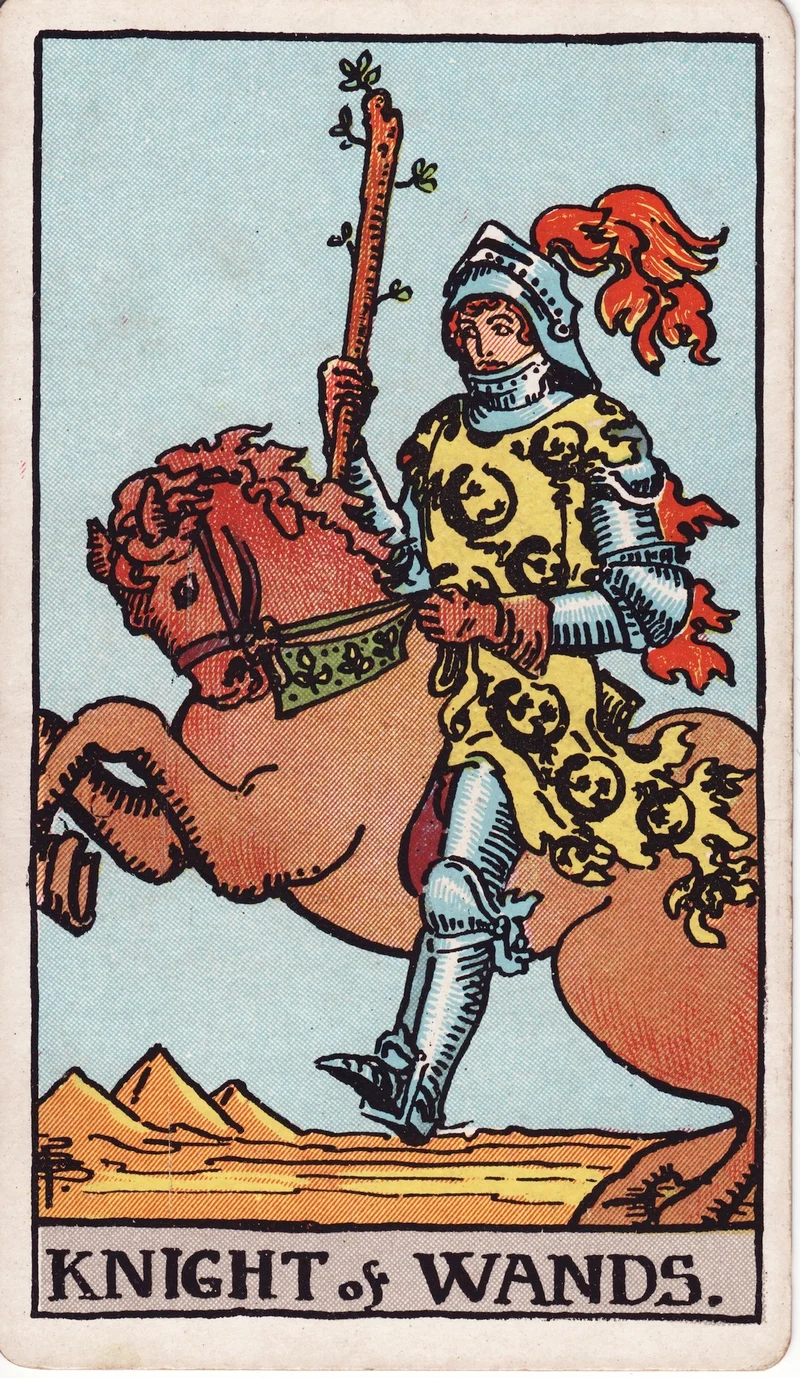
He is shewn as if upon a journey, armed with a short wand, and although mailed is not on a warlike errand. He is passing mounds or pyramids. The motion of the horse is a key to the character of its rider, and suggests the precipitate mood, or things connected therewith. Divinatory Meanings: Departure, absence, flight, emigration. A dark young man, friendly. Change of residence. Reversed: Rupture, division, interruption, discord.
Card image: Pamela Colman Smith’s original RWS design, using the Commons Pam-A scans.
Historical reversal and interpretation
Rupture, division, interruption, discord.
Contemporary reading
Consider the historical conditions above; a reversal is not a uniform opposite. Compare them with our modern theme: Relate the card to confirmed facts, unfulfilled commitments and conditions for your next step.
Relate it to your question
Separate known facts, unconfirmed information and available actions. Which part of this symbol fits, and which does not?
Read the original English and source
Pamela Colman Smith · Image source / Public domain ↗
He is shewn as if upon a journey, armed with a short wand, and although mailed is not on a warlike errand. He is passing mounds or pyramids. The motion of the horse is a key to the character of its rider, and suggests the precipitate mood, or things connected therewith. Divinatory Meanings: Departure, absence, flight, emigration. A dark young man, friendly. Change of residence. Reversed: Rupture, division, interruption, discord.
A. E. Waite · Knight of Wands ↗Bring the symbol into your day
How might “Adventure and drive” relate to your circumstances? List the facts you already know, then consider one action within your control.
Primary texts you can consult
《周易》· Chinese Text Project ↗
Read the judgments and line texts separately from the later commentarial Wings. Traditional authorship accounts are not treated as established historical fact.
Zhouyi, received text · Digital Chinese Classics ↗
Each hexagram’s classical text is extracted from its chapter. Traditional characters and editorial punctuation are retained; modern annotations are not reproduced.
A. E. Waite · The Pictorial Key to the Tarot ↗
First published in 1910; our reference is the 1911 text transcribed by Sacred Texts. Written by A. E. Waite, with original card designs by Pamela Colman Smith.
Historical imagery and symbolism
He is shewn as if upon a journey, armed with a short wand, and although mailed is not on a warlike errand. He is passing mounds or pyramids. The motion of the horse is a key to the character of its rider, and suggests the precipitate mood, or things connected therewith. Divinatory Meanings: Departure, absence, flight, emigration. A dark young man, friendly. Change of residence. Reversed: Rupture, division, interruption, discord.
Card image: Pamela Colman Smith’s original RWS design, using the Commons Pam-A scans.
Contemporary reading
Keep enthusiasm in action while making room for follow-through.
Relate it to your question
Separate known facts, unconfirmed information and available actions. Which part of this symbol fits, and which does not?
Read the original English and source
Pamela Colman Smith · Image source / Public domain ↗
He is shewn as if upon a journey, armed with a short wand, and although mailed is not on a warlike errand. He is passing mounds or pyramids. The motion of the horse is a key to the character of its rider, and suggests the precipitate mood, or things connected therewith. Divinatory Meanings: Departure, absence, flight, emigration. A dark young man, friendly. Change of residence. Reversed: Rupture, division, interruption, discord.
A. E. Waite · Knight of Wands ↗