The Hanged Man
倒吊人
The Hanged Man
Upright · a modern reflection
Pause and perspective. Suspending action may reveal a different understanding.
Reversed · another perspective
Stagnation or needless sacrifice. Ask whether the pause still serves a purpose.
These are our original interpretations of RWS imagery, not word-for-word translations of Waite. Reversals offer another angle, not a verdict of bad luck.A. E. Waite · XII. The Hanged Man
“The gallows from which he is suspended forms a Tau cross, while the figure--from the position of the legs--forms a fylfot cross. There is a…”This English excerpt comes from the original card chapter. We use Pamela Colman Smith’s original RWS images from the Commons Pam-A scans. The design originated in 1909; this scan set is dated 1910.
Read this card’s original chapter ↗Historical imagery and symbolism
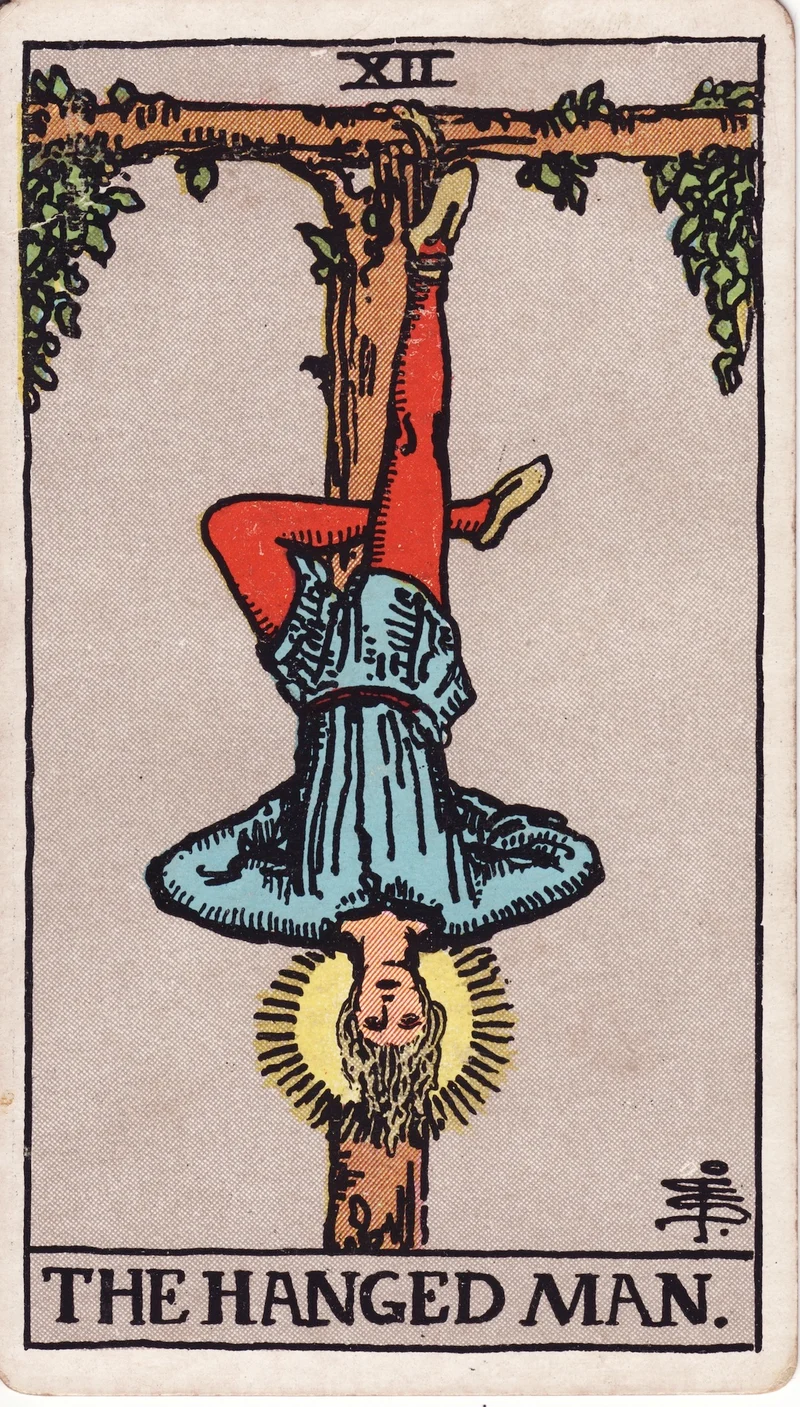
The gallows from which he is suspended forms a Tau cross, while the figure--from the position of the legs--forms a fylfot cross. There is a nimbus about the head of the seeming martyr. It should be noted (1) that the tree of sacrifice is living wood, with leaves thereon; (2) that the face expresses deep entrancement, not suffering; (3) that the figure, as a whole, suggests life in suspension, but life and not death. It is a card of profound significance, but all the significance is veiled. One of his editors suggests that Éliphas Lévi did not know the meaning, which is unquestionable nor did the editor himself. It has been called falsely a card of martyrdom, a card a of prudence, a card of the Great Work, a card of duty; but we may exhaust all published interpretations and find only vanity. I will say very simply on my own part that it expresses the relation, in one of its aspects, between the Divine and the Universe.
Card image: Pamela Colman Smith’s original RWS design, using the Commons Pam-A scans.
Historical reversal and interpretation
Selfishness, the crowd, body politic.
Contemporary reading
Consider the historical conditions above; a reversal is not a uniform opposite. Compare them with our modern theme: Stagnation or needless sacrifice. Ask whether the pause still serves a purpose.
Relate it to your question
Separate known facts, unconfirmed information and available actions. Which part of this symbol fits, and which does not?
Read the original English and source
Pamela Colman Smith · Image source / Public domain ↗
The gallows from which he is suspended forms a Tau cross, while the figure--from the position of the legs--forms a fylfot cross. There is a nimbus about the head of the seeming martyr. It should be noted (1) that the tree of sacrifice is living wood, with leaves thereon; (2) that the face expresses deep entrancement, not suffering; (3) that the figure, as a whole, suggests life in suspension, but life and not death. It is a card of profound significance, but all the significance is veiled. One of his editors suggests that Éliphas Lévi did not know the meaning, which is unquestionable nor did the editor himself. It has been called falsely a card of martyrdom, a card a of prudence, a card of the Great Work, a card of duty; but we may exhaust all published interpretations and find only vanity. I will say very simply on my own part that it expresses the relation, in one of its aspects, between the Divine and the Universe. He who can understand that the story of his higher nature is imbedded in this symbolism will receive intimations concerning a great awakening that is possible, and will know that after the sacred Mystery of Death there is a glorious Mystery of Resurrection.
12. THE HANGED MAN.--Wisdom, circumspection, discernment, trials, sacrifice, intuition, divination, prophecy. Reversed: Selfishness, the crowd, body politic.
A. E. Waite · XII. The Hanged Man ↗Part III §3 · Major divinatory meanings, distinct from Part II symbolism ↗
Bring the symbol into your day
How might “The Hanged Man” relate to your circumstances? List the facts you already know, then consider one action within your control.
Primary texts you can consult
《周易》· Chinese Text Project ↗
Read the judgments and line texts separately from the later commentarial Wings. Traditional authorship accounts are not treated as established historical fact.
Zhouyi, received text · Digital Chinese Classics ↗
Each hexagram’s classical text is extracted from its chapter. Traditional characters and editorial punctuation are retained; modern annotations are not reproduced.
A. E. Waite · The Pictorial Key to the Tarot ↗
First published in 1910; our reference is the 1911 text transcribed by Sacred Texts. Written by A. E. Waite, with original card designs by Pamela Colman Smith.
Historical imagery and symbolism
The gallows from which he is suspended forms a Tau cross, while the figure--from the position of the legs--forms a fylfot cross. There is a nimbus about the head of the seeming martyr. It should be noted (1) that the tree of sacrifice is living wood, with leaves thereon; (2) that the face expresses deep entrancement, not suffering; (3) that the figure, as a whole, suggests life in suspension, but life and not death. It is a card of profound significance, but all the significance is veiled. One of his editors suggests that Éliphas Lévi did not know the meaning, which is unquestionable nor did the editor himself. It has been called falsely a card of martyrdom, a card a of prudence, a card of the Great Work, a card of duty; but we may exhaust all published interpretations and find only vanity. I will say very simply on my own part that it expresses the relation, in one of its aspects, between the Divine and the Universe.
Card image: Pamela Colman Smith’s original RWS design, using the Commons Pam-A scans.
Contemporary reading
Pause and perspective. Suspending action may reveal a different understanding.
Relate it to your question
Separate known facts, unconfirmed information and available actions. Which part of this symbol fits, and which does not?
Read the original English and source
Pamela Colman Smith · Image source / Public domain ↗
The gallows from which he is suspended forms a Tau cross, while the figure--from the position of the legs--forms a fylfot cross. There is a nimbus about the head of the seeming martyr. It should be noted (1) that the tree of sacrifice is living wood, with leaves thereon; (2) that the face expresses deep entrancement, not suffering; (3) that the figure, as a whole, suggests life in suspension, but life and not death. It is a card of profound significance, but all the significance is veiled. One of his editors suggests that Éliphas Lévi did not know the meaning, which is unquestionable nor did the editor himself. It has been called falsely a card of martyrdom, a card a of prudence, a card of the Great Work, a card of duty; but we may exhaust all published interpretations and find only vanity. I will say very simply on my own part that it expresses the relation, in one of its aspects, between the Divine and the Universe. He who can understand that the story of his higher nature is imbedded in this symbolism will receive intimations concerning a great awakening that is possible, and will know that after the sacred Mystery of Death there is a glorious Mystery of Resurrection.
12. THE HANGED MAN.--Wisdom, circumspection, discernment, trials, sacrifice, intuition, divination, prophecy. Reversed: Selfishness, the crowd, body politic.
A. E. Waite · XII. The Hanged Man ↗Part III §3 · Major divinatory meanings, distinct from Part II symbolism ↗