Judgement
审判
Judgement
Upright · a modern reflection
Reflection and a call to respond. Understand past choices and decide how to move forward.
Reversed · another perspective
Self-criticism or delay. Turn criticism into a change you can practice.
These are our original interpretations of RWS imagery, not word-for-word translations of Waite. Reversals offer another angle, not a verdict of bad luck.A. E. Waite · XX. The Last Judgement
“I have said that this symbol is essentially invariable in all Tarot sets, or at least the variations do not alter its character. The great…”This English excerpt comes from the original card chapter. We use Pamela Colman Smith’s original RWS images from the Commons Pam-A scans. The design originated in 1909; this scan set is dated 1910.
Read this card’s original chapter ↗Historical imagery and symbolism
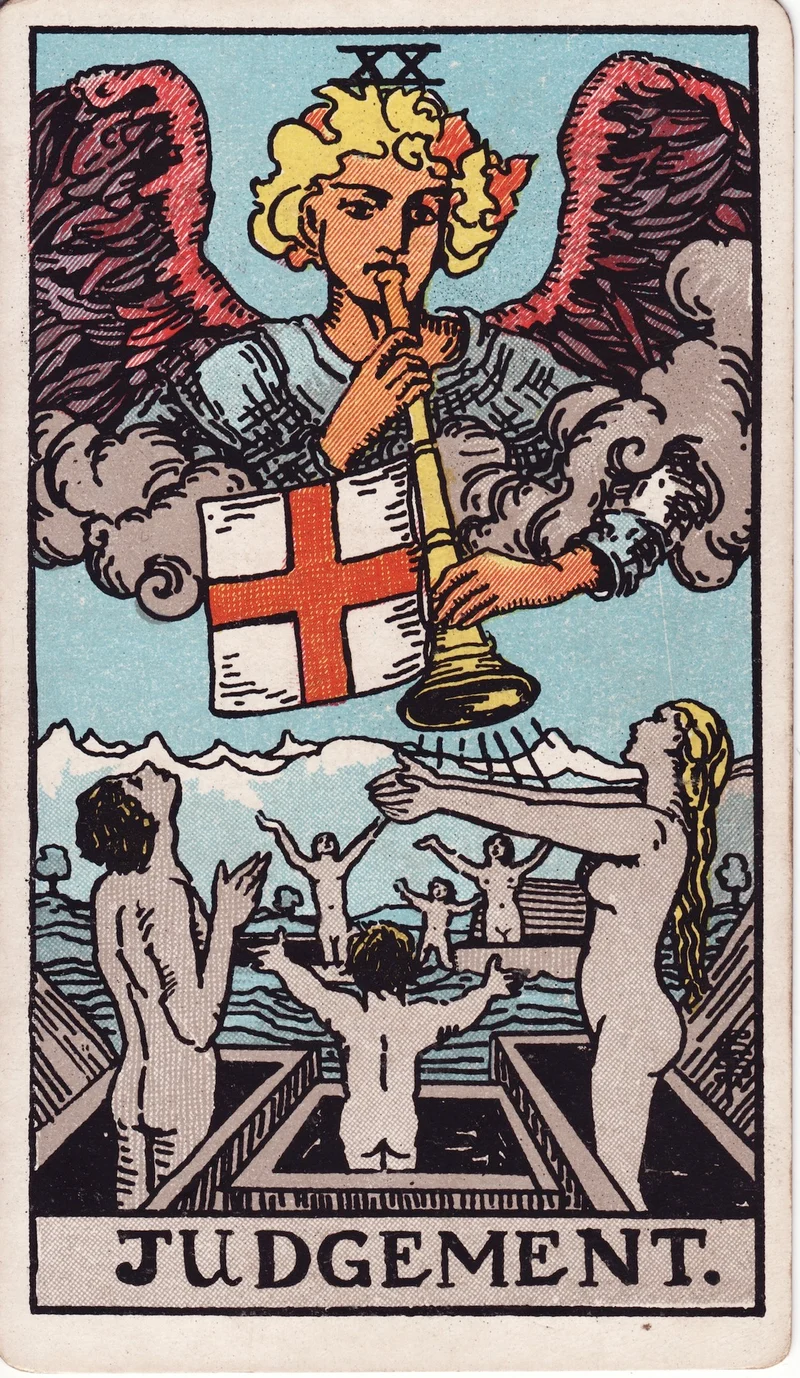
I have said that this symbol is essentially invariable in all Tarot sets, or at least the variations do not alter its character. The great angel is here encompassed by clouds, but he blows his bannered trumpet, and the cross as usual is displayed on the banner. The dead are rising from their tombs--a woman on the right, a man on the left hand, and between them their child, whose back is turned. But in this card there are more than three who are restored, and it has been thought worth while to make this variation as illustrating the insufficiency of current explanations. It should be noted that all the figures are as one in the wonder, adoration and ecstacy expressed by their attitudes. It is the card which registers the accomplishment of the great work of transformation in answer to the summons of the Supernal--which summons is heard and answered from within.
Card image: Pamela Colman Smith’s original RWS design, using the Commons Pam-A scans.
Historical reversal and interpretation
Weakness, pusillanimity, simplicity; also deliberation, decision, sentence.
Contemporary reading
Consider the historical conditions above; a reversal is not a uniform opposite. Compare them with our modern theme: Self-criticism or delay. Turn criticism into a change you can practice.
Relate it to your question
Separate known facts, unconfirmed information and available actions. Which part of this symbol fits, and which does not?
Read the original English and source
Pamela Colman Smith · Image source / Public domain ↗
I have said that this symbol is essentially invariable in all Tarot sets, or at least the variations do not alter its character. The great angel is here encompassed by clouds, but he blows his bannered trumpet, and the cross as usual is displayed on the banner. The dead are rising from their tombs--a woman on the right, a man on the left hand, and between them their child, whose back is turned. But in this card there are more than three who are restored, and it has been thought worth while to make this variation as illustrating the insufficiency of current explanations. It should be noted that all the figures are as one in the wonder, adoration and ecstacy expressed by their attitudes. It is the card which registers the accomplishment of the great work of transformation in answer to the summons of the Supernal--which summons is heard and answered from within. Herein is the intimation of a significance which cannot well be carried further in the present place. What is that within us which does sound a trumpet and all that is lower in our nature rises in response--almost in a moment, almost in the twinkling of an eye? Let the card continue to depict, for those who can see no further, the Last judgment and the resurrection in the natural body; but let those who have inward eyes look and discover therewith. They will understand that it has been called truly in the past a card of eternal life, and for this reason it may be compared with that which passes under the name of Temperance.
20. THE LAST JUDGMENT.--Change of position, renewal, outcome. Another account specifies total loss though lawsuit. Reversed: Weakness, pusillanimity, simplicity; also deliberation, decision, sentence.
A. E. Waite · XX. The Last Judgement ↗Part III §3 · Major divinatory meanings, distinct from Part II symbolism ↗
Bring the symbol into your day
How might “Judgement” relate to your circumstances? List the facts you already know, then consider one action within your control.
Primary texts you can consult
《周易》· Chinese Text Project ↗
Read the judgments and line texts separately from the later commentarial Wings. Traditional authorship accounts are not treated as established historical fact.
Zhouyi, received text · Digital Chinese Classics ↗
Each hexagram’s classical text is extracted from its chapter. Traditional characters and editorial punctuation are retained; modern annotations are not reproduced.
A. E. Waite · The Pictorial Key to the Tarot ↗
First published in 1910; our reference is the 1911 text transcribed by Sacred Texts. Written by A. E. Waite, with original card designs by Pamela Colman Smith.
Historical imagery and symbolism
I have said that this symbol is essentially invariable in all Tarot sets, or at least the variations do not alter its character. The great angel is here encompassed by clouds, but he blows his bannered trumpet, and the cross as usual is displayed on the banner. The dead are rising from their tombs--a woman on the right, a man on the left hand, and between them their child, whose back is turned. But in this card there are more than three who are restored, and it has been thought worth while to make this variation as illustrating the insufficiency of current explanations. It should be noted that all the figures are as one in the wonder, adoration and ecstacy expressed by their attitudes. It is the card which registers the accomplishment of the great work of transformation in answer to the summons of the Supernal--which summons is heard and answered from within.
Card image: Pamela Colman Smith’s original RWS design, using the Commons Pam-A scans.
Contemporary reading
Reflection and a call to respond. Understand past choices and decide how to move forward.
Relate it to your question
Separate known facts, unconfirmed information and available actions. Which part of this symbol fits, and which does not?
Read the original English and source
Pamela Colman Smith · Image source / Public domain ↗
I have said that this symbol is essentially invariable in all Tarot sets, or at least the variations do not alter its character. The great angel is here encompassed by clouds, but he blows his bannered trumpet, and the cross as usual is displayed on the banner. The dead are rising from their tombs--a woman on the right, a man on the left hand, and between them their child, whose back is turned. But in this card there are more than three who are restored, and it has been thought worth while to make this variation as illustrating the insufficiency of current explanations. It should be noted that all the figures are as one in the wonder, adoration and ecstacy expressed by their attitudes. It is the card which registers the accomplishment of the great work of transformation in answer to the summons of the Supernal--which summons is heard and answered from within. Herein is the intimation of a significance which cannot well be carried further in the present place. What is that within us which does sound a trumpet and all that is lower in our nature rises in response--almost in a moment, almost in the twinkling of an eye? Let the card continue to depict, for those who can see no further, the Last judgment and the resurrection in the natural body; but let those who have inward eyes look and discover therewith. They will understand that it has been called truly in the past a card of eternal life, and for this reason it may be compared with that which passes under the name of Temperance.
20. THE LAST JUDGMENT.--Change of position, renewal, outcome. Another account specifies total loss though lawsuit. Reversed: Weakness, pusillanimity, simplicity; also deliberation, decision, sentence.
A. E. Waite · XX. The Last Judgement ↗Part III §3 · Major divinatory meanings, distinct from Part II symbolism ↗